Showing posts with label emily warren roebling. Show all posts

Thursday, March 21, 2019

Celebrating Women's History Month with Helena Fairfax' Struggle and Suffrage in Halifax

Hello and Welcome to the Girls Succeed Blog! 

According to the National Women's History Month Website, "every year, March is designated Women’s History Month by Presidential proclamation. The month is set aside to honor women’s contributions in American history."
On the Girls Succeed blog, we are proud to celebrate women who in the past or present have made a difference in their communities, regions, states, and countries. 
I'm excited to share a new book by my friend, Helena Fairfax, who reveals the lives of women in Halifax who fought for equality and the right to vote in England. England is celebrating the 100th anniversary this year by recognizing their determination and achievement in working for the vote. 
Let me introduce you to Helena's new book, just released in February to mark this important occasion.
NEW RELEASE: Struggle and Suffrage in Halifax (England): Women's Lives and the Fight for Equality by Helena Fairfax
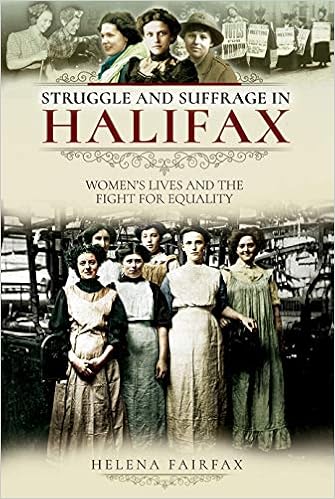
STRUGGLE AND SUFFRAGE IN HALIFAX:
WOMEN'S LIVES AND THE FIGHT FOR EQUALITY
BY HELENA FAIRFAX

BACK OF THE BOOK: Between 1800 and 1950 the town of Halifax grew beyond recognition. The booming mills and factories were built on the labour of women and their children, and yet their voices are almost completely missing from the history books. For the first time, this is the story of Halifax from the point of view of the women who helped shape the town. This was a period of extraordinary change, but the battle for equality was long. In 1800, many women were illiterate. By 1900, there was a thriving girls' high school in Halifax, and yet one of its most brilliant students was denied a full degree because she was a woman. In 1939, the Vicar of Halifax called women's economic independence "an evil".Families were large and women regularly died in childbirth. Many faced the stigma of single parenthood or else the terror of an illegal abortion. In the 1930s, the first Family Planning Clinic was set up by women in the town. In the 1840s, women in Halifax fought for their menfolk's right to vote. In 1911, when Emmeline Pankhurst gave a stirring speech at the Mechanics' Institute, women had yet to be granted a vote of their own, leading many women to boycott that year's census and at least two to declare their occupation as "slave".From girls in the factories to the first women stepping into public office, this book provides a fascinating and moving account of the lives of Halifax's women through the key events in the town's history.

Order your copy at amazon
***
Helena Fairfax tells us the stories of the lives of the women in Halifax, England in the county of Yorkshire and how they gained the right to vote in her new release. She writes in her blog "6th February 2018 marks 100 years since the Representation of the People Act when all women over the age of 30 who met certain property restrictions were granted the vote for the first time. The Act also gave the right to vote to all men over the age of 21. It’s often forgotten that before 1918, around 40% of men in Britain were also denied a vote because of property restrictions. The vote was finally extended to all women over 21 in 1928." 
Click here to read more information in Helena's blog post.
***
Click on the links below to take you to stories of Emily Roebling who built the Brooklyn Bridge in New York and the WWII Women's Air Force Service Pilots featured on the Girls Succeed blog. 
Bridge Builder Emily Warren Roebling
Women's Air Force Service Pilots (WASP)

Thank you for stopping in.  Please leave your email address in the box at the top of the sidebar to keep up to date for the next blog post at Girls Succeed!

Thursday, October 24, 2013

Trailblazer: Bridge Builder Emily Warren Roebling by Carol Simon Levin


 Thank you to Carol Simon Levin for sharing this article about Emily Warren Roebling.

Bridge Builder in Petticoats: Emily Warren Roebling and the Brooklyn Bridge


On December 12, 1881, people in New York City would have witnessed a strange sight.  High above the East River, men in business suits were walking cautiously along a narrow path of wooden boards laid across the steel frame of a huge bridge.  Strangest of all, the line was led by a woman, her long skirt billowing as she showed them details of the construction.  When they reached the New York side, everyone toasted her with champagne.  It was the first official crossing of the Brooklyn Bridge.

In 1881, women could not vote in most state and federal elections.  Their minds and bodies were considered weak and fragile. Very few colleges accepted female students and, though poor women worked, it was unthinkable for respectable middle and upper-class women to do so.  They most certainly would not be helping to supervise the greatest construction project of the age.   

But Emily Warren Roebling was doing just that.  

After her husband Washington Roebling, the Chief Engineer of the bridge, became an invalid from injuries received on the project, Emily became his eyes and ears, feet and hands and voice.  She started out carrying his orders back and forth to the site. When he became unable to read or write, she read aloud all written material to him and wrote his responses. Since Washington could not talk to anyone but Emily without becoming exhausted, he began discussing all the details of the bridge with her, expecting that she would explain these to the assistant engineers.  As a result, although she never went to an engineering university, Emily gradually learned quite a lot about bridge engineering. 

For nearly eleven years, the bridge company kept her work a secret. (They worried that the public would lose confidence in the safety of the project if they knew a woman was involved.)  Her role was finally revealed on May 24, 1883 at the opening ceremonies when Congressman Abram S. Hewitt honored her work in a speech. 
Later that day, The Brooklyn Eagle publicly praised Emily in its article on the opening of the bridge:
Great emergencies are the opportunities of great minds.  Mrs. Emily Roebling met this difficulty as nobody else could.  She addressed her remarkable intelligence to the acquisition of the higher mathematics...  She mastered this most bewildering of sciences, applied it to the bridge, was in rapport with her husband, and dazzled and astounded the engineers by her complete and intelligent conception of their chief’s theories and plans…Day after day, when she could be spared from the sickroom, in cold and in wet, the devoted wife exchanged the duties of chief nurse for those of chief engineer of the bridge, explaining knotty points, examining results for herself, and thus she established the most perfect means of communication between the structure and its author.  How well she discharged this self-imposed duty the grand and beautiful causeway best tells.

Emily did not rest on her accomplishments. After the bridge, she helped design the family mansion in Trenton, studied law, attended the coronation of the Tsar of Russia and even took tea with Queen Victoria.  At the time of her death, she was called “one of the most distinguished women in the country” and “the most famous woman in New Jersey” – yet today most people don’t even know her name!
If you walk across the bridge, be sure look  at the bronze plaque on the East Tower.  It states:

The Builders of the Bridge
Dedicated to the Memory of
Emily Warren Roebling
1843-1903
whose faith and courage helped her stricken husband
Col. Washington A. Roebling, C.E.
1837-1926
complete the construction of this bridge
from the plans of his father
John A. Roebling, C.E.
1806-1869
who gave his life to the bridge
“BACK OF EVERY GREAT WORK WE CAN FIND THE SELF-SACRIFICING DEVOTION OF A WOMAN.”

Carol Simon Levin is a librarian at the Somerset County Library and a member of the New Jersey Storyteller’s Network. She impersonates Emily and other forgotten women in presentations available for libraries, senior centers, historical societies and other venues.   Programs are accompanied by a "lantern slide show" (PowerPoint) with photographs and lithographs.  They can be tailored for adult or youth audiences. For further information, write her at cslevin59 (at) gmail (dot) com.  For more information about Emily Roebling, check out www.bridgebuilderinpetticoats.com.